

The short answer: before you buy, check your pipe diameter against your run length, decide whether you need an oxygen barrier, confirm the insulation quality, plan your burial depth, and make sure your fittings match your furnace brand.
If you already own an outdoor wood furnace, or you are about to install one, you already know the furnace itself is only half the system. The other half is the pipe running underground from the firebox to your house, barn, shop, or pool. That pipe carries hot water across your yard every single day of the heating season, and if it is undersized, poorly insulated, or installed the wrong way, you will feel it in your heating bill and in how warm your home actually gets.
Buying boiler pipe is not as simple as grabbing whatever length is on sale. Underground insulated PEX pipe is a system, not just a tube, and a few decisions made before you order will affect how efficiently your furnace runs for the next twenty or thirty years. Here are five things worth thinking through first.
1. Pipe Diameter and How Far the Water Has to Travel
The most common mistake people make is choosing a pipe diameter based on price instead of distance. A short run to a garage twenty feet away does not need the same pipe as a run of two hundred feet to a farmhouse.
For most residential setups, 1-inch PEX is the standard choice and can comfortably handle runs up to 200 feet, with some installers using it successfully even at 250 feet or more. Going bigger is not automatically better either. A pipe that is too wide for the flow rate can actually slow the water down and increase heat loss, since the water spends more time in the ground before it reaches the building. For longer distances or larger heat loads, such as heating more than one building from a single furnace, a 1.25-inch pipe is generally the better call.
If you are unsure what your specific run requires, OutdoorBoiler.com’s collection of underground insulated pipe breaks down the available diameters and lengths so you can match the pipe to your layout rather than guessing.
Quick sizing reference
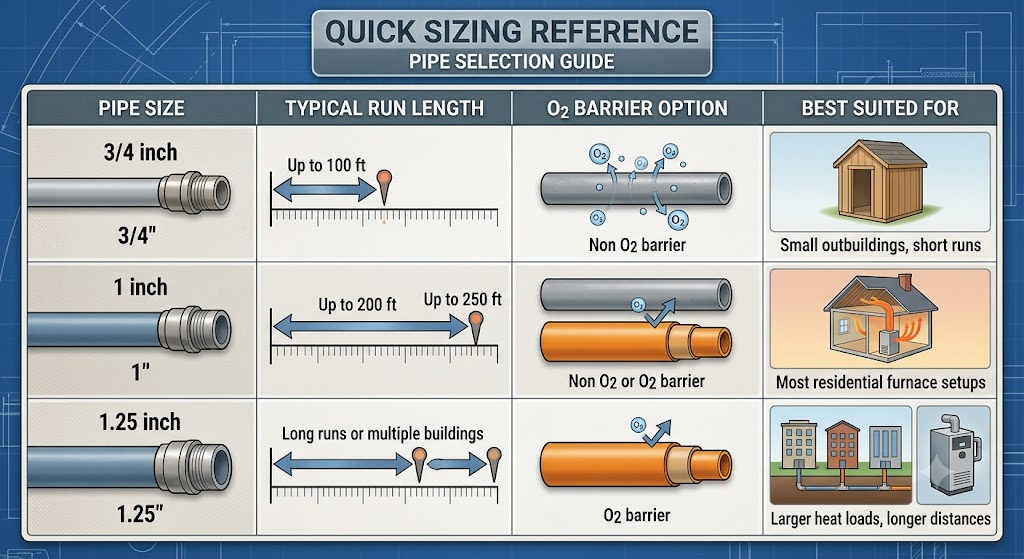
Run lengths above are general guidelines. Your actual sizing should also factor in your furnace’s BTU output and the heat loss of the space you are heating.
2. Oxygen Barrier or Non-Oxygen Barrier
This is a detail that is easy to overlook, but it matters depending on what kind of system you have. PEX pipe is available with or without an oxygen barrier, which is a layer that prevents outside air from diffusing into the water inside the pipe.
For non-pressurized, open-loop outdoor furnaces, which describe most wood and outdoor boiler setups, pipe without an oxygen barrier is generally fine. But if your system includes metal components like a cast-iron heat exchanger or steel fittings that could corrode from oxygen exposure over time, an oxygen barrier version is worth the extra cost. It protects the metal parts of your system from rust and extends the life of components you would otherwise have to replace.
This is one of those choices where it pays to know your own setup before you order, since swapping pipe after it is buried is not a quick fix.
3. Insulation Quality, Not Just Insulation Thickness
All insulated PEX pipes look similar from the outside, but the insulation inside is where the real performance difference lies. The supply and return lines run side by side inside a single outer casing, and the insulation around them is what determines how much heat you lose before the water ever reaches your house.
Poor quality insulation, or insulation that has gaps and seams, can lead to significant heat loss over the long run. Some manufacturers wrap their pipe in multiple layers specifically to reduce this loss, with claims of less than one degree of heat loss over 100 feet when the insulation is done right.
It is also worth understanding why end caps matter here. The space between the insulation and the outer casing is meant to stay dry. If water gets into that space, it ruins the insulation’s effectiveness and can damage the pipe from the inside out, which is why proper sealing at both ends of the run is not optional. You can read more about how end caps protect the pipe in this insulated PEX pipe with a warranty overview.
4. Burial Depth and Trench Planning
Before any pipe goes in the ground, the trench itself needs some thought. The general rule of thumb is to bury insulated PEX pipe below your local frost line, which in most regions means a depth of at least two feet, though colder climates may require deeper burial.
A few practical points worth planning ahead of time:
Call your local utility locating service before digging, since you need to avoid tree roots, septic lines, wells, and buried electrical or gas lines. If you are also running a power cable to the furnace for circulation pumps, plan that trench at the same time so you are not digging twice. Where the pipe comes up out of the ground and into the furnace or the house, you will need extra depth, often around four feet, to allow the pipe to bend gradually instead of kinking.
A trench about 6 inches wide is usually enough for the pipe itself, though if you are also burying electrical wire alongside it, a wider trench with proper separation between the two is safer.
5. Fittings, Warranty, and Compatibility with your Furnace
The pipe is only one part of the system. The fittings that connect it to your furnace and to your home’s heat exchanger need to match both the pipe diameter and your furnace brand. Mismatched fittings are a common cause of leaks at connection points, which is frustrating to deal with after the trench has already been backfilled.
This is also the point where it is worth checking what kind of warranty coverage comes with the pipe you are buying. A pipe that is buried underground is not something you want to dig up again in five years because of a manufacturing defect. Look for coverage that includes the pipe itself and, ideally, labor in case something does go wrong.
If you are unsure what fittings or pipe diameter will work with your specific furnace, it is worth asking before you order rather than after the trench is dug.
Frequently Asked Questions
How deep should insulated PEX pipe be buried for an outdoor furnace? Most installations bury the pipe at least two feet deep, below the local frost line. Colder climates may require more depth, and your local building code is the final word on this.
Can an insulated PEX pipe handle the high temperatures from a wood furnace? Yes. PEX pipe used for outdoor furnace applications is rated for the temperatures these systems produce, and properly insulated PEX can last for several decades underground when installed correctly.
What size PEX pipe do I need for my outdoor furnace? For most residential systems, 1-inch PEX handles runs up to 200 to 250 feet. Longer runs or larger heating loads, such as heating more than one building, often call for 1.25-inch pipe.
Do I need an oxygen barrier on my pipe? Not always. Open-loop, non-pressurized outdoor furnace systems generally do not need one, but systems with metal heat exchangers or steel fittings benefit from the added corrosion protection.
How long does underground insulated PEX pipe last? When installed correctly and properly sealed at both ends, insulated PEX pipe can last several decades, often outlasting the building it is heating.
Conclusion
Choosing the right boiler pipe for your outdoor furnace comes down to a handful of decisions made before the trench is ever dug: the right diameter for your run, the right barrier type for your system, insulation you can actually trust, a trench planned with your climate in mind, and fittings that match your equipment. Get these right the first time, and you will spend far less time and money dealing with problems underground.
If you are planning an installation or just want a second opinion on what your setup needs, contact us, and we will help you work through the details before you buy.